


Country -
Beyond the boom

Success for rural landowners depends on what they grow, but also how strategically they use their land to manage risk and leverage new opportunities.
Bayleys national director rural, Duncan Ross, says volatile commodity cycles, climate risk and rising production costs are prompting savvy landowners – particularly those in horticulture or viticulture – to consider alternative income streams to spread risk, while leveraging existing infrastructure.
New Zealand agriculture has repeatedly experienced ‘boom-and-adjust’ cycles as growers and producers respond to price signals.
“When oversupply collides with changes in regulation, market access or consumer behaviour, prices suffer and growers or producers are left with carrying sometimes heavy losses from the upfront investment made in getting involved,” Ross says.
Recent examples of sectors going through re-adjustment include honey, hops, and Rockit™ apples.
The mānuka honey boom saw rapid hive expansion following strong international demand. But subsequent oversupply, price corrections and grading complexity exposed the risks of fast adoption without long-term demand certainty.
Hop plantings expanded on the back of global craft beer growth, yet market concentration and contract dependency created exposure when demand patterns shifted.
The early success of Rockit™ apples demonstrated the power of intellectual property-driven horticulture, but also highlighted high capital costs and the importance of strong market channels.
Rockit™ apples has tripled production since Cyclone Gabrielle, including to the South Island, but established growers say after paying the six-figure per hectare fee for licensing and absorbing all the crop costs, current returns from their orchards fall well short of breakeven.
In contrast, sectors led by coordinated marketing, strong intellectual property (IP) and export discipline – such as Zespri-backed kiwifruit – illustrate how scale, governance and market access underpin durable growth.
Kiwifruit hit rock bottom in the late 1990s, but Zespri emerged out of the crash and is now riding the crest of a wave of soaring demand, with sales in the past year worth $6 billion, and setting its sights on earning the claim of being the world’s healthiest fruit brand by 2035.
Emerging sector
A new industry increasingly entering the diversification conversation is medical cannabis, also experiencing a boom in global demand. Global legal cannabis sales are forecast to rise from around $47 billion today to $149 billion by 2031.
“While the sector remains young and tightly regulated, a new cohort of science-led companies is attempting to build scalable, export-focused models,” Ross says.
“Among them, Marlborough-based Puro is emphasising premium organic production, genetics and technology-driven processing as a pathway to differentiation, rather than volume.”
Puro is positioning itself at the intersection of science and organics and is about to release a new contract growing option — raising a timely question for rural landowners: could medicinal cannabis become the next meaningful diversification play?
Ross says Puro’s strategy reflects a lesson learned across multiple horticultural sectors: oversupply erodes value quickly when product becomes commoditised.
Medicinal cannabis appears to be following a similar pattern - early excitement, capital inflows, consolidation and a shift towards premium, science-led operators.
Growers have to navigate through licensing and regulation, New Zealand’s medicinal cannabis framework is tightly controlled, requiring significant compliance investment and time to gain approval.
Several New Zealand cannabis companies have faced receivership, restructuring or investor losses, reinforcing caution among rural investors.
These realities suggest medicinal cannabis is unlikely to be a broad-acre transition crop in the near term. Instead, Ross says it may remain a specialised diversification option aligned with strong partners.
“One of the lessons learned from past boom-and-adjust sectors is the need for growers to link with the right partners,” Ross says.
Viticulture crossover
Puro’s strategy will appeal to operators in the viticulture sector who share a similar controlled growing expertise and a good understanding of the importance of the need for sound pre- and post-harvest processing techniques.
“Grape growers also understand the role of premium branding pathways and the export dominance of markets for New Zealand wine,” he says.
Growers facing grape price pressure or climate variability may see cannabis as a complementary crop, rather than a replacement. The ability to repurpose greenhouse infrastructure or diversify blocks could become particularly attractive if contract grower models mature.
“For rural property owners, the key question is not whether cannabis will grow – but which operators will endure,” Ross says.
Puro testing contract grower model
Puro is poised to expand production through a network of contracted growers to supply more outdoor-grown, organic product for burgeoning global markets.
Puro chairman Tim Aldridge says developing a contract grower network was always part of the company’s original strategy, formed when Puro was founded in 2018.
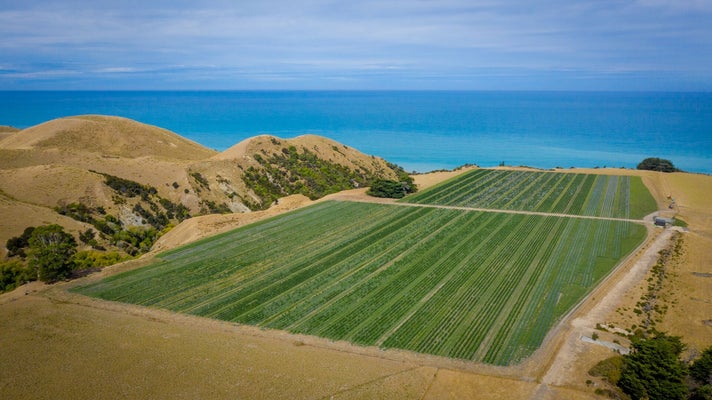
Its first cannabis plants went into 10 hectares of terrace country in 2020, on Puro co-founder and chief executive Sank Macfarlane’s coastal family farm, overlooking Kekerengu, south of Blenheim.
Aldridge says the initial plan was to prove the concept of growing medical cannabis plants outdoors, using organic principles, and ensure the harvested buds and leaf met the top-tier quality standard demanded for pharmaceutical medicines.
Instead of attempting to be a fully vertically integrated business from plant to patient, like many of the other registered medical cannabis companies in New Zealand, Puro remains focused on genetics and seed research, indoor and outdoor organic production systems, and post-harvest processing.
Its product is then sold to pharmaceutical companies who handle the retailing of medicines to clinics and patients.
Puro has already bagged the world’s largest organic medicinal cannabis supply contract, a $16 million deal signed in 2025 with IPS Pharma, a pharmaceutical company in the United Kingdom.
“From the outset, we set up to own our niche in the value chain and then we partner with other companies that we can add value to and vice-versa, to form a supply chain both in New Zealand and globally. And it's been proven to be quite successful,” Aldridge says.

Measured expansion
Puro is already scaling production at Kekerengu with 70,000 new plants being planted this year, up from 15,000 the previous year, and extra planting at its indoor facility in the Waihopai Valley, west of Blenheim.
“There's a lot to learn around which cultivars grow best in each environment, but the beauty of decentralising and putting these contract growers out in different parts of the country is we will get different cannabinoids from each plant and therefore different formulations and different medicines from them,” Macfarlane says.
Contract growers will be licensed to use Puro’s cultivars which have been developed in conjunction with a research programme run by the company and the Ministry for Primary Industries (MPI).
Puro was awarded a $13 million grant from MPI in 2022 and is investing a further $19 million in the programme to develop genetic material suitable for the New Zealand industry, refine organic production systems and release a handbook to encourage other growers to join the industry.
Puro is also developing its indoor production systems and post-harvest processing technology. A good example of post-harvest technology is its ‘live-dry’ system which is a modified version of freeze-drying that helps to lock in the aroma and colour of the cannabis leaf and buds immediately after harvest.
“So, we’re going to take all those individual pieces of technology and knowledge, and build it into our contract grower network,” Aldridge says.
“As long as the quality specifications are met, we will either buy product back or take it through as a joint venture, with that grower, through to market.”
Macfarlane says the company has already received significant interest from landowners keen to get involved, sometimes fielding several emails a week.
“There's a lot of interest but it's making sure that we scale at a rate that our customers are growing at too. I guess we get one shot to get it right and we want to make sure the model is correct,” he says.
Premium parallels
Aldridge says the aim is to have a globally recognised brand like Zespri.
Cannabis grows almost anywhere but to grow medical cannabis consistently up to pharmaceutical standards without any heavy metal pesticides or hormone treatments is very challenging, he says.
“Our business model is almost unique globally which is why it is actually receiving a lot of attention from global buyers and it's also why we've managed to secure a very significant export deal into the UK market with IPS Pharma,” he says.
Macfarlane says it is difficult to project the likely returns a contract grower might receive from Puro and warns growers will need to patient and adaptable as partnerships develop and sales grow.
“The opportunity can be significant when pharmaceutical quality standards are achieved, though the capital and operational requirements are substantial. Success ultimately depends on disciplined growers who can consistently deliver premium-grade product.”
Aldridge agrees that quality is crucial in such a hands-on industry.
“It’s a new industry and there's no automation like the grape industry, so all the work is manually done,” Aldridge says.
“The risk is if you don't get the quality right, it could easily become expensive compost.”
Puro is targeting global customers seeking elite quality and product differentiation which should enable the company to reward contract growers with high, consistent margins.
The systems and procedures are being checked with a small group of partners first, before releasing contracts to a wider group.
“We are certainly happy to have conversations with individuals and landowners that are contemplating entering in this industry, but it will take a bit of time before we're in a position where we are comfortable to be able to push go,” Aldridge says.

Rural landowners are watching
Ross says contract growing is emerging as a potential entry point for landowners without taking on full processing or market risk.
The contract grower model could appeal particularly to viticulture growers facing price pressure or vintage variability, greenhouse operators seeking higher-value crops, lifestyle blocks with suitable microclimates or horticultural producers wanting portfolio diversification.
“Cannabis production requires controlled environments, compliance systems and traceability capabilities that many vineyard and high-value horticulture operators already understand,” he says.
In theory, contract models allow growers to split revenue risk across crops; leverage existing infrastructure; maintain land use flexibility and participate in export growth sectors.
However, Ross says the economics remain highly sensitive to licensing costs, yields, processing margins and market access.
Ross says medicinal cannabis is unlikely to be a universal land use shift — but it may become an important strategic diversification tool for certain growers.
“The parallels with honey, hops and branded horticulture are instructive: rapid expansion creates noise, but long-term value tends to concentrate among operators with strong IP, disciplined growth and clear market channels,” he says.
This approach mirrors premiumisation trends seen in wine, kiwifruit and niche horticulture — where intellectual property and quality control drive margins more than sheer production volume.
“For landowners, that focus matters. It suggests participation may be less about converting entire farms and more about specialised, high-value production partnerships,” Ross says.
Puro’s focus on organics, genetics and technology positions it within that premium narrative, he says.
“For rural landowners and investors, the opportunity may not lie in chasing the trend — but in understanding when the sector moves from niche to structural growth.”
Contact us


