


Commercial -
Precinct in transition, site at the centre
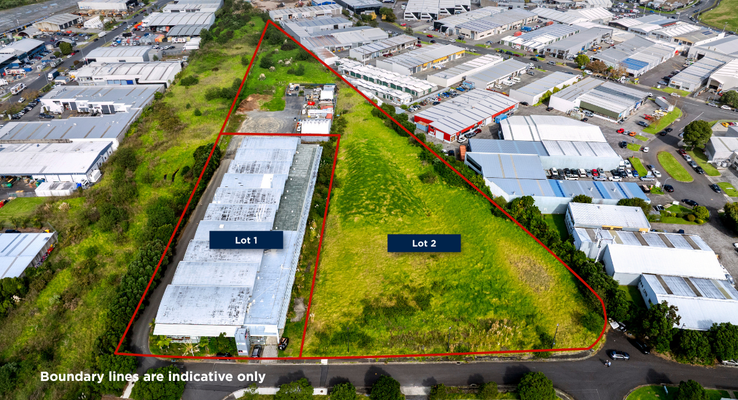
A significant mixed-use landholding within Auckland’s evolving Tāmaki regeneration corridor is being brought to market, offering investors, developers and long-horizon capital a rare opportunity to secure scale, holding income and strategic flexibility at the centre of one of the region’s largest urban transformation projects, Bayleys brokers say.
Bayleys Metro Markets director, Layne Harwood, together with colleagues Charlie Tudehope and James Valintine, is marketing the freehold property at 255 and 259 Morrin Road, St Johns, on behalf of the receivers of Shundi Tamaki Village Limited (in Receivership), Stephen Keen and Stephen White of Teneo Financial Advisory New Zealand Limited.
The property is being offered for sale by International Expressions of Interest, closing at 4:00 pm on Thursday, 18th June 2026 (unless sold prior).
Harwood says the offering represents one of the largest development opportunities remaining within Auckland’s eastern suburbs, combining immediate income, substantial existing improvements and flexible zoning across a 2.31ha (more or less) landholding.
“Capital is increasingly concentrating around precincts where infrastructure, planning momentum and surrounding development activity have already established the direction of long-term growth,” he says.
“That materially changes risk. Purchasers are no longer speculating on whether intensification will occur; they’re assessing how and when to position themselves within it.”
Held across two titles, the offering combines substantial existing improvements with a significant vacant development site, returning holding income of $497,437 pa plus GST through a mix of short-term leases and license agreements, with redevelopment termination provisions designed to support future activation.
The property includes the former Ray Meyer Research Centre, developed by the University of Auckland during the 1990s. The approximately 4,795sqm industrial-style facility was purpose-built for research, laboratory, and technical operations, creating a substantial existing infrastructure capable of supporting a range of interim commercial, industrial, or adaptive-reuse outcomes.
The adjoining 1.74ha (more or less) vacant landholding provides one of the larger remaining development footprints within the immediate St Johns area, with services available at the boundary and access secured via the precinct’s established internal roading network.
Bayleys Capital Markets’ client solutions manager, Charlie Tudehope, says that structure provides purchasers with unusual flexibility in a market where timing and versatility are increasingly influencing acquisition strategies.
“Across the market, sophisticated capital is placing greater emphasis on flexibility rather than committing immediately to a single end use,” he says. “This offering allows purchasers to secure a strategic position within a transforming precinct while retaining the ability to respond to changing market conditions over time.”
The property is zoned Business – Mixed Use, enabling a broad range of commercial, trade-oriented, light industrial and residential activities.
Bayleys Industrial Sales director, James Valintine, says the site’s existing access arrangements, interface with surrounding industrial occupiers, and substantial existing improvements may support efficient near-term commercial or light industrial outcomes, while retaining longer-term residential potential as the precinct evolves.
“Few sites offer this level of flexibility within such a tightly held urban location,” he says.
“An owner could pursue staged development, reposition the existing improvements, retain part of the holding for income, or align future land use with the broader evolution of the surrounding precinct.”
Located within the former University of Auckland Tāmaki Campus, the property sits immediately adjacent to Te Tauoma, the large-scale masterplanned regeneration project expected to deliver more than 1,500 residential dwellings alongside supporting retail, commercial and community infrastructure.
The wider precinct has already established a benchmark for future density and built form, with adjoining consented development providing for apartment buildings of up to 18 levels, delivered in stages.
Harwood says major regeneration projects are increasingly shifting investment focus toward established middle-ring suburbs where infrastructure, transport connectivity and intensification are beginning to converge.
“Morrin Road is in that transition,” he says. “The combination of scale, infrastructure readiness, flexible zoning and immediate proximity to one of Auckland’s largest regeneration projects creates an opportunity for developers, institutional groups and long-term capital to secure a strategic foothold within a precinct where the direction of growth is already becoming clear.”
Contact us


